
Miroslav Vasilev
2025
According to ancient geographical conceptions, Thrace and Macedonia were neighbouring regions, whose boundary in earlier times followed the lower course of the Strymon River, and later the lower course of the Nestus River. The proximity presupposes the existence of intensive cultural, economic and political interactions. Information on the earliest of these can be found in Thucydides’ excursus (II.99) devoted to the territorial extent of the Temenid kingdom. According to him, Alexander (c. 498–c. 454 BC), the father of Perdiccas, and his ancestors conquered that part of current (at the time of Thucydides) Macedonia, which lay by the sea. They expelled some Thracian tribes from there: the Pierians from Pieria (mid-7th century BC) and the Bottiaei (of disputable origin) from Bottia (mid-7th century BC). Beyond the Axius River, they conquered Mygdonia (the end of the 6th–the beginning of the 5th century BC) as far as the Strymon whence they drove out the Edonians. Furthermore, they ruled over Crestonia and Bisaltia (c. 460 BC). Therefore, at that time some of the lands to the west of the Strymon and even of the Axius, which from a certain moment onwards fell within the borders of the Macedonian kingdom, were peopled by Thracians. We should also note Herodotus’ reference (VI.45) to the clash of the Persian commander Mardonius with the Thracian Brygi somewhere in Macedonia (492 BC), i.e. to the west of the Strymon. The early stage of the expansion of the Temenids, described by Thucydides, was characterised by the expulsion of the existing Thracian population, while the later phase probably involved its integration. As a result of the aggressive policy pursued, in the mid-5th century BC the eastern border of the Temenid kingdom reached the lower course of the Strymon, and, on the basis of disputed information by Demosthenes (XII.20–21), conquest of territories to the east of that river is also assumed.
Data on later clashes are again provided by Thucydides (II.95–96, 98, 100–101). They concern the campaign of the Odrysian king Sitalces (mid-5th century–424 BC) against the Macedonian ruler Perdiccas II (c. 454–414 BC) and the Chalcidians, carried out at the beginning of the winter of 429 BC. Two years earlier, through the mediation of Nymphodoros of Abdera, Sitalces concluded an alliance with Athens. Finding himself in difficulty, Perdiccas had given Sitalces certain promises (unspecified by Thucydides), which he was to honour if the Odrysian king succeeded in reconciling him with the Athenians and provided that he did not restore the power of his brother and enemy Philip. Following Perdiccas’ failure to fulfil the promises and pursuing his own interests, or fulfilling his obligations as an ally of Athens, Sitalces marched against Macedonia with a huge army (429 BC). He brought with him Amyntas, the son of Phillip, whom he destined for the throne of Macedonia, as well as some Athenians and the commander Hagnon. His army gathered in the Paeonian settlement of Doberos, whence they invaded the former domain of Phillip: Eidomene was taken by force; Gortynia, Atalante and some other places by negotiation because of their friendship with Amyntas; Europos was besieged, but not seized. The army next advanced into the part of Macedonia to the left of Pella and Cyrrhus and devastated Mygdonia, Crestonia and Anthemus, while the Macedonians, not being in a position to resist the numerous enemies, withdrew into fortified settlements and fortresses. Meanwhile Sitalces opened negotiations with Perdiccas, but, after realising that the Athenian fleet would not come to his add, he dispatched part of his army against the Chalcidians and the Bottiaei. Finding that he was not succeeding in any of the objectives of his invasion, and that his army was without provisions and was suffering from the severity of the season, Sitalces was persuaded by his nephew Seuthes – who was of greatest authority next to himself – to hasten away. Seuthes was engaged in secret negotiations with Perdiccas who promised him his sister in marriage and money. After a stay of a full 30 days, eight of which were spent in Chalcidice, the Odrysian army returned. Later, the Perdiccas honoured his promise and gave his sister Stratonice in marriage to Seuthes. The events described reflect the most serious interference of a Thracian royal house into the internal affairs of the Macedonian kingdom.
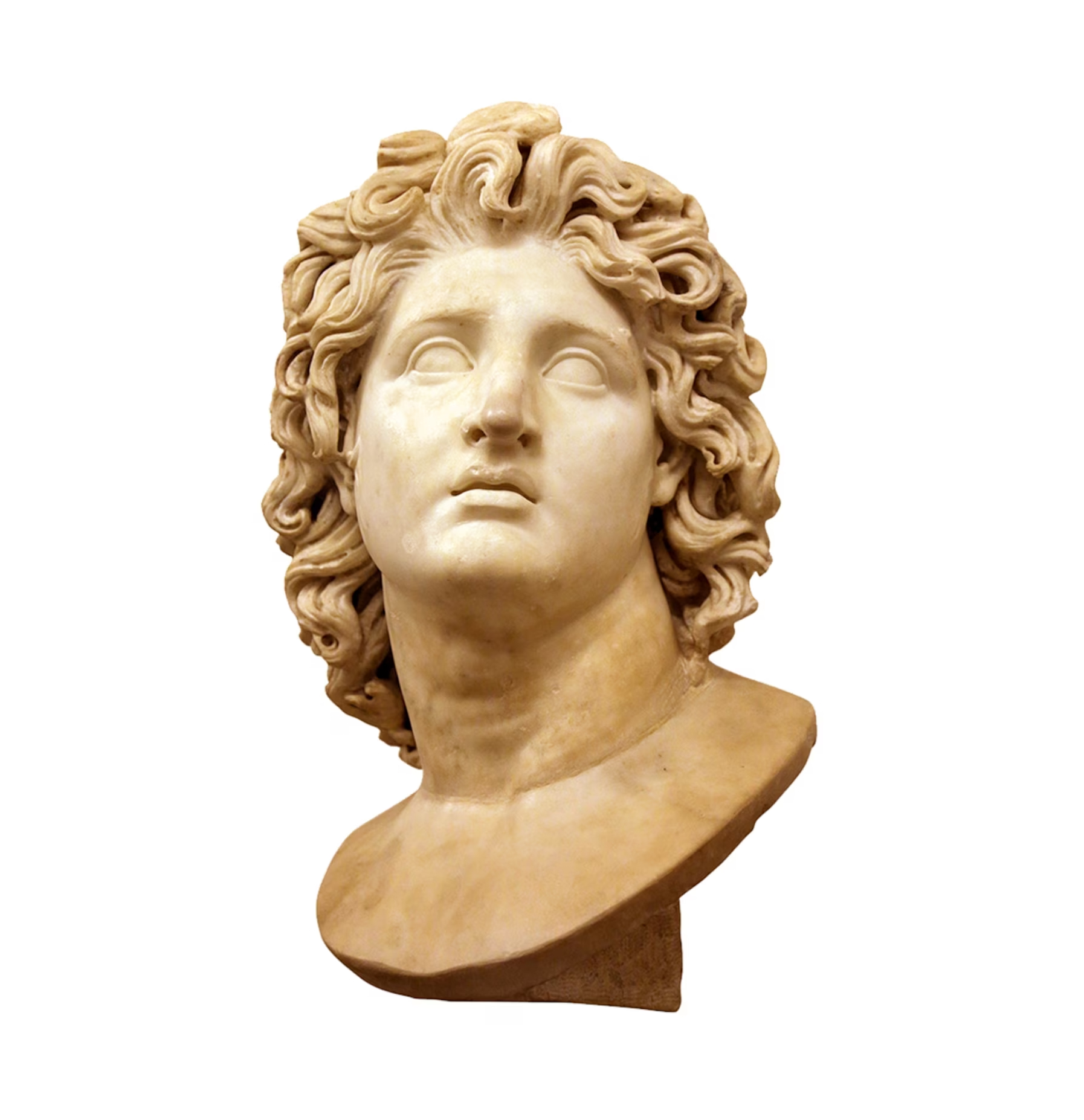
Head of Alexander the Great as Helios. Roman copy after an Hellenistic original, from Carrara, Italy, 3rd–2nd century BCE. © Capitoline Museum of Rome, Stanza del Gladiatore 3
In 360/359 BC Philip II assumed control over Macedonia, whether as ruler or as regent for the young Amyntas. He found himself in a very difficult situation due to the hostility of the Paeonians and the Illyrians, as well as the ambitions of Argaeus and Pausanias to claim the Macedonian throne (Diod. XVI.2.6). Pausanius was supported by an anonymous Thracian king (identified with either Cotys I, or Cersobleptes or Berisades). This support, however, was lost after Philip won over the king in question with gifts (Diod. XVI.3.4). This was the second case of serious Thracian interference in the domestic affairs of Macedonia. After consolidating his power and reorganising the army, Philip began to pursue an active foreign policy, which especially affected the Thracians. His activities in this regard were consistent and in line with the current political situation. In 358 BC, pushed by the Thracians, the citizens of Crenides asked Philip for help. He fortified the settlement, increased its size with a large number of inhabitants, changed its name to Philippi, and turned to the gold mines in its territory (Diod. XVI.8.6; App. BC IV.105; St. Byz. Φίλιπποι). Two years later, Philip’s swift actions succeeded in breaking up the anti-Macedonian alliance between the Illyrian ruler Grabus, the Paeonian Lyppeius, and the Thracian Cetriporis and his brothers (Rhodes and Osborne 2007: p. 254–259, nо. 53; Diod. XVI.22.3). They were all forced to join forces with the Macedonians. In 354 or 353 BC, the Macedonian king turned his attention again to the East: he accompanied Pammenes who marched towards Asia Minor. Upon reaching Maroneia, Amadocus, the ruler of the region, forbade Philip from proceeding further (Demosth. XXIII.183). The first significant involvement of Philip in Thrace could be dated to 352/351 BC when his support was sought by Amadocus, who himself encountered difficulties during his war with Cersobleptes (Schol. Aesch. II.81). The latter had territorial disputes with the Hellenic poleis of Perinthus and Byzantium (FGrHist 115 F 101), which made Philip’s task easier. In November/December, the Odrysian residence of Heraion Teichus was placed under a prolonged siege (Demosth. III.4). The lack of Athenian help forced Cersobleptes to seek peace. According to the agreement concluded, he had to return the disputed territories to Perinthus and Byzantium and send one of his sons as a hostage in Pella. Often considered a prelude to these events is an account according to which Philip was invited to settle a dispute between two Thracian rulers (identified either as Cetriporis and Mononius, or as Amadocus and Cersobleptes), who were brothers, but instead of dealing with their problems, he directly annexed the lands they ruled (Just. VIII.3.14–16). In 347 BC, the Macedonian commander Antipater succeeded in annexing several Hellenic poleis located in Thrace. In the following year, a new campaign was launched against Cersobleptes (Aesch. II. 90, 92), who quickly capitulated (21st April 346 BC) and was probably forced to retreat inland. In 343/342 BC, the Odrysian ruler ravaged the territories of the Hellespontine poleis (Diod. XVI.71.1), which indicates that he still retained some military capability. Philip’s response was devastating: after a difficult and prolonged campaign (342/341 BC) Cersobleptes lost his kingdom; a tribute was imposed on the subjugated Thracians; the conquered lands (of uncertain territorial extent) were distributed among Macedonian aristocrats; and new poleis were found, in which Macedonian garrisons were stationed and colonists were settled (Demosth. VIII. 35–37, 44–45; FGrHist 115 F 110; Diod. XVI.71.2; Athen. VI. 261a). Because of the attested revolt (in 340/339 BC?) of the Thracians tetrachoritai (FGrHist 115 F 217, 218), it is assumed that, at least initially, Macedonian power in the interior of Thrace was not particularly stable. In the summer of 339 BC, Philip invaded the lands to the north of Haemus, this time targeting the elderly Scythian king Ateas (Just. IX. 2). After defeating the Scythians in battle and killing their ruler, Philip decided to return via the lands of the Triballians. He refused to share the Scythian spoils with them, which led to him being attacked and defeated. His horse was killed in the battle and he himself was wounded in the left thigh. His alliance with the Getae and his marriage to Medope, the daughter of the ruler Gudila (Jord. Get. 65; see also Athen. XIII.557d), are also commonly associated with his Scythian campaign. The fate of the Odrysian kingdom remains unclear, with scholarly opinions ranging from its complete destruction to its placement under vassalage with severely reduced territory. Equally diverse are the opinions regarding the geographical extent of the Macedonian power imposed by Philip (ranging north to the Phillippopolis–Cabyle line, to Haemus, to the Istrus River, etc.), as well as his colonisation policy.
At the approach of spring (335 BC), Alexander III marched towards Thrace, since he ascertained that the Triballians were meditating a change of policy, and in view of his upcoming campaign against Persia, he did not consider it appropriate to leave his neighbours behind him without their having been entirely subjugated (Arr. Anab. I.1.4–5.1). Due to limited information, the route he followed cannot be established with precision. Setting out from Amphipolis, he invaded the land of the autonomous Thracians, keeping the city of Philip and Mount Orbelus on the left. Crossing the Nestos River, he arrived at Mount Haemus on the tenth day, where he encountered the so-called emporitai and the autonomous Thracians, who were overcome with relative ease. These events were followed by a successful battle with the Triballians at the Lyginus River (identified with the Kamchiya, the Yantra, the Rositsa, the Nishava, etc.) and an unsuccessful attempt to land on the island of Peuce (identified with Peuce island in the Danube delta, with Belene island, etc.), where the Triballian king Syrmus had fortified himself. Alexander then attacked the Getae, who dwelt on the other side of the Istrus, devastated their lands, and returned to the camp. There envoys came to him from the other autonomous tribes dwelling near the Istrus, from Syrmus, and from the Celts living around the Ionian Gulf. After exchanging oaths of loyalty with all of them, he left for the lands of the Agrianes and the Paeonians. Assessments of the results of the campaign vary significantly: from the assertion that Thrace was annexed and the Istrus became Macedonia’s northern border, to the conclusion that the expedition had no impact on the political development of the Getae. A Macedonian strategos was sent to Thrace (Arr. Anab. I.25.1–2) – Alexander, son of Aeropus, from the royal house of the Lyncestians, who assumed the position some time after the death of Phillip II (October 336 BC) and was recalled before the summer of 334 BC. The same office was held by Memnon, who is known to have incited the barbarians, and revolted against Alexander III in 331 BC (Diod. XVII.62.4–5). Another Macedonian official in Thrace during this period was Zopyrion, attested as praepositus of Thrace and praefectus of the Pontus (Curt. X.1.44; Just. XII.2.16). Upon learning of the catastrophic outcome of Zopyrion’s campaign against the Getae, Seuthes incited the Odrysians to revolt (between 331 and 325 BC), which resulted in the near-complete loss of Thrace. After the death of Alexander (June 323 BC), Lysimachus became a governor of Thrace (since c. 305/304 BC – king). During his rule (as satrap and king) he waged war with varying success against both Seuthes and Dromichaetes (Diod. XVIII.14.2–4; XIX.73.8-9; XXI.12.1–6; Strabo VII.3.8, 14; Paus. I.9.6).
Thrace occupied an important place in Philip V’s foreign policy (221–179 BC). His first offensive against the Thracians (c. 211 BC) was conducted during the First Macedonian War (215–205 BC). Philip left his son Perseus to guard the mountain passes from Thessaly against a possible Aetolian attack, entered the lands of the Maedi, devastated them, and laid siege to Iamphorina. Although the settlement surrendered and the campaign was progressing successfully, Philip was compelled to cease hostilities due to the deteriorating situation on other fronts (Livy XXVI.25.5–8, 15). After his defeat in the Second Macedonian War (200–197 BC) and the restrictions imposed upon him by the Romans, Philip was in a position (to some extent) to pursue an active policy, mainly against the Thracians. This included three campaigns, the first of which was directed against the Thracians above the Propontis who were harassing the citizens of Byzantium (c. 184 BC). He defeated them in a battle and captured their leader Amadocus (Polyb. XXII.14.12; Livy XXXIX.35.4). Shortly thereafter (c. 183 BC), Philip conducted a campaign unlike any seen since the time of Alexander III. After crossing through the middle of Thrace, he attacked the Odrysians, Bessi and Denteletae. Coming to the so-called city of Philip, whose inhabitants had fled, he captured it in the first assault. He then traversed the whole plain, and after devastating some and taking oaths of allegiance from others, he returned, leaving a garrison in the city of Philip. Sometime later, the garrison was expelled by the Odrysians who broke their pledges to the king (Polyb. XXIII.8.3–7; also, Livy XXXIX.53.12–14). The third recorded campaign of Philip in Thrace dates to 181 BC. His army gathered at Stobi in Paeonia, and from there he led them into Maedica. Philip decided to ascend the peak of Mount Haemus, as he believed that the Pontus, the Adriatic, the Istrus River and the Alps could all be seen from there, which might be of use in his plans for war against Rome (Livy XL.21.1–3, 22.1–14). After a strenuous but successful ascent of the summit with a few companions, Philip withdrew through the lands of his allies, the Dentheletae, which were pillaged by his exhausted soldiers. Carrying off a supply of corn he returned to Maedica and besieged the settlement of Petra, whose inhabitants surrendered and gave hostages. However, they did not remain loyal to the Macedonians – as soon as the Macedonian army had withdrawn, they deserted their city and fled to fortified places and the mountains. An interesting element of Philip’s domestic policy was the settlement of parts of Macedonia with Thracians in order to increase the kingdom’s population (Livy XXXIX.24.3–4).
At the very beginning of Perseus’ reign (179–168 BC) the Sapaean ruler Abrupolis attempted to seize the Pangaean mines. However, he was defeated and expelled from his own domains by the Macedonian king (Polyb. XXII.18.2–4; Diod. XXIX.33.1; Livy XL.13.5; App. Mac. 1.6; Paus. VII.10.6). During the Third Macedonian War (171–168 BC), one of Perseus’ key allies was the Odrysian king Cotys, son of Seuthes, whose warriors distinguished themselves in the campaign of 171 BC (Livy XLII.51.10, 57.6, 59.1–60.2). However, Cotys’ lands were attacked by the Thracian ruler Autlesbis and Corrhagus, prefect under Eumenes, which forced him to return to his kingdom (Livy XLII.67.3–5). After the Battle of Pydna (22nd June 168 BC), which marked the end of Antigonid Macedonia, Cotys successfully withdrew with his Odrysians, following the fleeing Perseus (Livy XLIV.42.2).
REFERENCES
Илиев, Й. 2023. Тракия и траките в политиката на Рим и Македония по времето на Филип V (221-179 г.пр. Хр.). Плевен.
Йорданов, К. 2000. Политическите отношения между Македония и тракийските държави (359 – 281 пр. Хр.). София.
Петков, П. 2012. Военно-политически отношения на тракийските владетели в Европейския югоизток между 230/229 г. пр. Хр. – 45/46 г. сл. Хр. Велико Търново.
Rhodes, P. and Osborne, R. 2007. Greek Historical Inscriptions 404 – 323 B.C. Oxford 2007.
Vasilev, M. I. 2011. Thucydides II,99 and the early expansion of the Argeadae. Eirene 47, 93-105.
Vasilev, M. I. 2011. The Military-Political Campaign of Sitalces against Perdiccas II and the Chalcidians (431-429 BC). Živa Antika 61, 15-38.