
Plamen Petkov
2025
Philip V (221–179 B. C.) invaded Thrace’s inland launching a military campaign against the Thracian ethnic communities of the Odrysai, Denteleti and Bessi, in order to draw off the attention of the Romans from his actual plans. The Macedons took deserted Philippopolis, its inhabitants having broken away to the woods, and destroyed the tilled land of the Thracians from the plains thus forcing them to surrender. The Macedon king deployed a garrison in Phlippopolis – soon driven away by the Odrysai – and decided to found a polis in Deuriopus, one of the Paionian districts near the river of Erigon [today’s Cherna Reka] flowing from Illyria through Paionia and running into the Axios, not far from the ancient settlement of Stobis. The newly founded polis was named Perseida, after and in honour of Perseus (179-168 B.C.) (Polyb. 23. fr. 8; Liv. 39. 53. 12-15).
The military campaign of Philip V to the inland of Thrace is traditionally dated back to 183 BC, though B. Gerov referred it to 184 BC. In the very same 183 BC, most likely, the Odrysai, under the command of Cotys, son of Seuthes, managed to drive away the Macedonian garrison from Philippopolis.
Polybius records: Soon afterwards this garrison (the Macedonian) was driven away by the Odrysai, who had broken their loyalty to the king (i.e. Philip V) (Polyb. 23. fr. 8; Liv. 39. 53. 14).
The operation of the Macedonian king in Thrace was first and foremost demonstrative – thereby the dynast intended to gain recognition and respect among the Thracian rulers on the eve of the impending war with the Roman Republic, i.e. Philip V was seeking to strengthen his authority among the Thracian ethnic communities – he had had considerable influence among them already since the end of the 3rd century BC, but he had not managed to achieve a position of stability.
Some modern researchers consider that the Thracian ethnonyms mentioned by the ancient authors do not exactly specify any particular ethnic communities – they rather seem to bear certain geopolitical contents – practically, the authors of these sources are alluding to the Thracians inhabiting the area of the Rhodope mountains, the upper and the lower reaches of the Hebros, as well as the upper reaches of the river Strymon.
The results of the military campaign definitely showed the Macedon ruler that he should not expect too much from his Thracian – allies the Thracian dynasts were plainly demonstrating the intention to pursue their own military-political course trying to profit from the forthcoming military operations in the European Southeast.
After a period of military-political and economic crisis the Odrysai once again gained an active and bright ruler by the accession of Cotys to the throne, the latter being explicitly specified by Livy as son of Seuthes: …uenerat eodem Cotys… (Liv. 42. 51. 10) and (beforehand) as king: Cotys Thrax, Odrysarum rex… (Liv. 42. 29. 102). Namely to Cotys, most likely, they refer the banishing of the Macedonian garrison from Philippopolis – an operation which brought him considerable authority and respect among the Thracians on the whole, and also became the reason for his ascent to the Odrysian throne. It was a phenomenon, not very often occurring among the Odrysai and the Thracians in general – a son to inherit his father to the throne – as they did not practice the tradition of royal succession, though ambitions and attempts of certain rulers to declare their son’s heirs to the throne have been recorded.
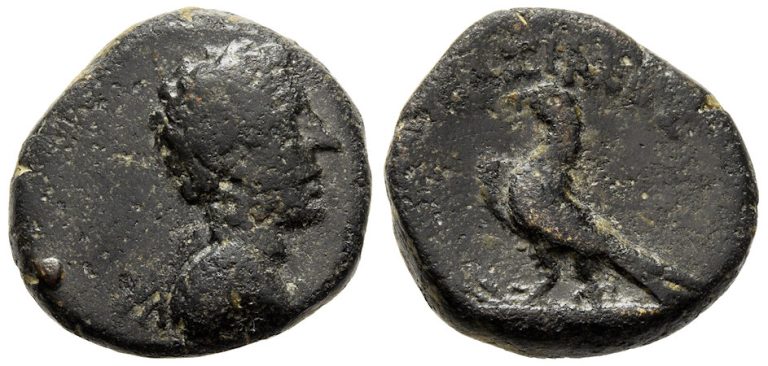
Bronze coin of Cothys, son of Seuthes, ca. 170-160 B.C., BG85630
Polybius was the first author to mention Cotys, the information being referred to 171/170 BC (Polyb. 27. fr. 12). He also invests him as king βασιλεύς with respect to the events from the end of the Third Macedonian War (171-168 BC) related to 167 BC. (Polyb. 30. fr. 17). Yet, as already mentioned above, Cotys must have ascended to the Odrysian throne most probably about 183 BC, after managing to drive away the Macedonian garrison from Philippopolis, or a little later. An evidence in support of this assumption may be the observed intensifying military-political activities of the ethnic community, obviously due to the dynastic changes within the Odrysian royal house. This, on its part, could mean, that during the III Macedonian War Cotys must have ruled durably and authoritatively enough to represent such a relevant factor in its course, as ancient written sources hold. He seems to have been sure enough of his (own) potential as he agreed to admit Perseus, who was forced to leave Macedonia after his brother Demetrius’ execution in 180 BC, in order to escape the rage of the repenting Philip V, thus opposing the Macedonian king himself (Liv. 40. 56. 1-2, 7).
This fact should be considered when analyzing the friendly relations between Cotys and Perseus during the III Macedonian War – they have dated namely since that time; during that very war the Odrysian king was the most relevant Macedonian ally. Besides, no wonder that the operation of the Sapai ruler Abrupolis in 179 BC was the only military reaction of the Thracians on the occasion of the death of Philip V and his son Perseus’ accession to the throne, known to contemporary researchers (Polyb. 22. fr. 18; Liv. 42. 13. 6). For his unimpeded ascent to the Antigonid throne the new Macedonian ruler owed a lot to the Odrysian king and his indisputable authority and respect among the Thracian dynasts. Good bilateral ties in 180 BC were yet to bring their positive impact and results to Perseus.
At the beginning of the III Macedonian War Perseus’ army numbered ca. 39 000 soldiers, 21 000 of them being phalangites and 4 000 – Macedonian and Thracian cavalrymen. Another 2 000 elite Odrysian soldiers [cavalry and infantry – 1000 soldiers each] were under the command of Cotys [the Odrysian warriors practically constituted ¼ of Perseus’ whole cavalry], and the rest of the soldiers were mercenaries including a large number of Celts. The Macedonian king could also rely on the back-up of the Paioni led by Didas.
The Roman troops were under the command of Consul Publius Licinius Crassus and amounted to about 40 000 men, and some additional 10 000 Numidian, Ligurian, Hellenic, Cretan and Pergamon military units.
Perseus did not dispose of a war navy, because according to the terms of the Peace Treaty entered into at the end of the Second Macedonian War [200-197 BC] the Antigonid dynasty should not possess war ships; so it was only on the eve of the III Macedonian War that Perseus thoroughly began to outfit a shipyard in Thessalonike, whereas the Romans could count on 40 (deck) ships with landing troops of about 10 000 men under the command of Gaius Lucretius (Liv. 42. 31. 2-7; 42. 32. 6; 42. 51. 3-11; 42. 52. 11; Eutr. 4. 6. 2).
Publius Licinius Crass deployed a strong military unit in Illyria to keep the western Macedonian border under (immediate) threat, while he was advancing ahead of the main Roman military forces on the traditional road from Apollonia to Thessaly (Liv. 42. 36. 8-9).
The Macedonian king did not attempt to block the passage through which the Roman troops were marching up – he rather decided to get in Perebia expecting to meet Publius Licinius Crass in the foothills of Ossa, near Syukyurion (Liv. 42. 53. 5-9; 42. 54. 1-11; 42. 55. 1-9; 42. 56. 1-10; 42. 57. 1-12).
The first battle of the III Macedonian War took place in 171 BC at the foot of mount Callinicus near Larissa, involving cavalry and lighter troops (peltasts). Cotys, the Odrysian king, defeated the Italics’ horse led by Gaius Licinius Crass, brother of Consul Publius Licinius Crass, and Perseus on his part put to rout the Thessaly cavalry (Liv. 42. 58. 1-14; 42. 59. 1-11; Eutr. 4. 6. 3).
Livy (Liv. 42. 59. 2) wrote: First and foremost the Thracians, like wild beasts that have been kept caged for a long time, attacked with such a frenzy and such a violent roar the right wing, where the Italics cavalry were fighting, that the latter, known as a people fearless by nature and steeled in battles, were thrown into confusion and dismay. Roman casualties in this fight amounted to ca. 2000 infantrymen and 200 horsemen, and ca. 600 warriors were taken prisoners-of-war; Perseus lost 40 foot soldiers and 20 cavalrymen. A particularly imposing scene must have represented the Thracians on their way back to the camp – carrying the heads of the killed enemies impaled on their lances, triumphantly singing a paean (Liv. 42. 60. 1-2; Plut. Ает. Paul. 9; Flor. 1. 28).
In this battle (171 BC) the Thracians for the first time met the Licinii, and this was going to have dramatic and tragic consequences for both sides. During the riots in Pergamon at the beginning of 130 BC the Roman Consul and Great Pontifex for the year 131 BC Publius Licinius Crassus Mucianus was taken prisoner-of-war by Aristonicus’ Thracian mercenaries and killed – he purposely challenged them to do this, thus not leaving the enemy the honour of keeping and triumphantly showing such a high-born prisoner to the demos. During the uprising of Spartacus, which shook Italy in the period 73–71 BC, the victorious Marcus Licinius Crass went through some very humiliating moments on the way to his goal (Plut. Crass 8-11; App. B. Civ. 1. 116-121; Eutr. 6. 7. 1). Namely those misadventures and reverses of the Licinii became the reason for the cruel attitude of Marcus Licinius Crassus, grandson of the homonymous victor over Spartacus, to the Thracians in 29-28 BC (Liv. Per. 134-135; Dio Cass. 51. 23) – his acting did not conform to the Roman military tradition, which did not imply atrocities unjustified from military-political point of view. The very same Marcus Licinius Crass was the actual conqueror of Thrace and the Thracians south of the river Istros in 29–28 BC, this act marking the end of the military conflicts between Licinii and Thracians; the beginning has to be referred to the year 171 BC, when the talented Odrysian king Cotys overwhelmingly defeated the Italics cavalry led by Gaius Licinius Crass, a very tough adversary on the battle-field.
REFERENCES
Strazzulla, V. 1901: ΘΡΑΙΚΗ. La serie dei re Odrisii dal 200 a. C. al 46 d. C. – Bessarione: Pubblicazione periodica di studi orientali, ser. 2, vol. 1, anno 6, fasc. 63, 364-380.
Геров, Б. 1959/1960: Проучвания върху западнотракийските земи през римско време, част, І. – ГСУ-ФФ, LІV/3, страници?.
Кабакчиев, Ю 2000: Summa Thracologiae 1: Наблюдения върху тракийската държавност, София.
Петков, П. 2011/2012: Военно-политически отношения на тракийските владетели в Европейския югоизток между 230/229 г. пр. Хр. – 45/46 г. сл. Хр., Велико Търново.
Тачева, М. 1997: История на българските земи в древността през елинистическата и римската епоха, София..
Тодоров, И. 1998: Неизвестните тракийски владетели 542–798 a. u. c., Велико Търново.